It's all about ski style...
Skiing pionieer Hannes Schneider
In the mountains of the Arlberg, a skiing style was developed that remains influential for modern skiing to this day. This is the birthplace of Alpine Skiing and Hannes Schneider was one of its prominent founding fathers. But what exactly is the 'Arlberg technique'?
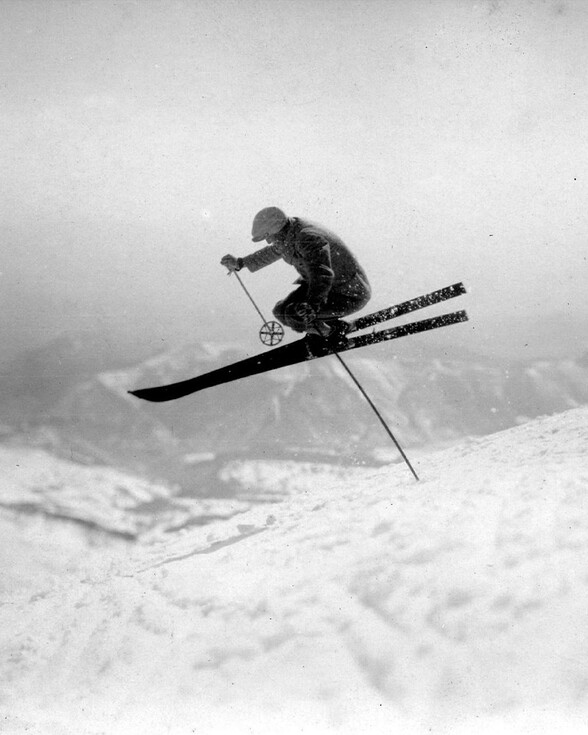
The story dates back to the early 20th century, around 1907. Hannes Schneider, then a young teenager, stood on the pistes of his birthplace, Stuben am Arlberg, teaching skiing to groups organized by ability level. He instructed them to shift their weight through the bends, sweeping energetically around turns to set their skis on the right track. For advanced skiers, he advocated a crouched squat position, known as the 'Arlberg crouch,' to increase speed and balance over uneven terrain as they raced downhill. Schneider's innovative teaching principles were grounded in the snowplough and stem turns with two poles, the precursor to the parallel turn, and the 'stem Christiania.' He explicitly rejected Telemark skiing. Enthusiastic students flocked to him in droves, eager to ski just like the illustrious Schneider. Consequently, in the winter of 1921/22, he established the world's first independent ski school in St. Anton am Arlberg.
A skiing pioneer as a mentor
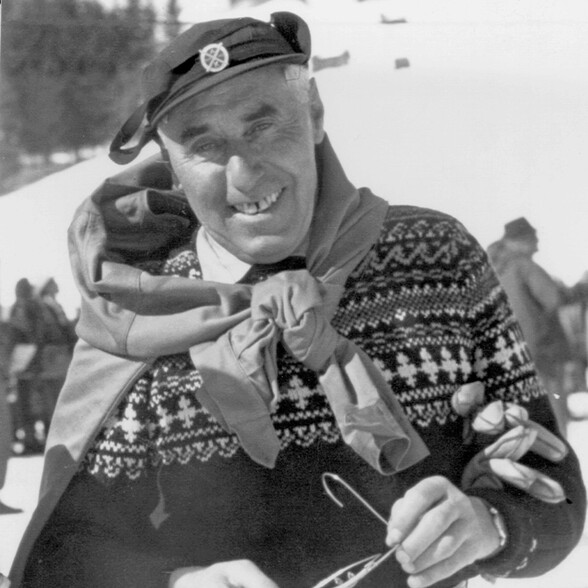
Delving further back in time, we find Johann Baptist, later known as Hannes Schneider, born on June 24, 1890. At just 10 years old, he witnessed the earliest skiers in Stuben, including Viktor Sohm, a pioneering figure from Dornbirn/Vorarlberg. What young Schneider saw would profoundly influence his life. Sohm was not merely traversing the snow on cross-country journeys; he was experimenting with skis from Norway, reveling in the thrill of racing down slopes. Inspired, the young Schneider implored a well-known sledge producer to craft a pair of skis for him, and soon he was seeking out every possible piste to practice his descent.
Around this pivotal period, on January 3, 1901, the Ski Club Arlberg extern was established at the Hospiz St. Christoph. Under the stewardship of Rudolf Gomperz and Carl Schuler, the club played a vital role in promoting skiing in the Arlberg region and nurturing the talents of the young Johann Schneider. Mentored by Sohm, Schneider immersed himself in a community passionate about skiing, staying abreast of the latest trends in techniques. He rapidly adapted and enhanced these methods, leading to significant achievements. In 1910 and 1911, he clinched the Ski Championships in downhill skiing for Switzerland. Remarkably, he did so as a professional ski instructor, navigating the regulations that governed amateur participation.
Skiing instructor and movie star
So back (or forward!) to the 1920/21 season: in line with the rapid expansion of his own ski school, Hannes Schneider (now a father of two) together with director and film producer Arnold Fanck began to make skiing popular, based on a previously unseen approach: Fanck created the first cinematic memorial to the Arlberg technique established by actor Hannes Schneider in his successful film ´The Wonders of Skiing´. An educational book by the same name was published in numerous languages and was regarded as a blueprint. Seven further films by Fanck followed. The film 'The White Thrill´ from 1931, featuring Leni Riefenstahl in the lead role, had the widest appeal.
An iconic race
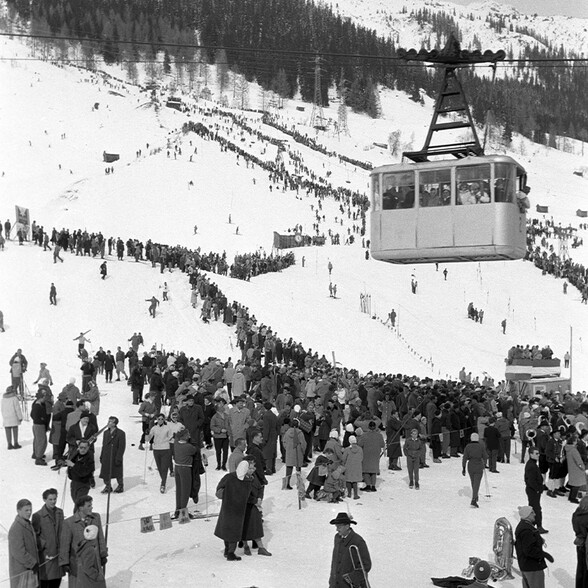
During a trip to St. Anton am Arlberg, Sir Arnold Lunn - a British ski association pioneer and relentless advocate for the recognition of Alpine downhill and slalom disciplines - encountered the 'god of skiing' from the 1920s, Hannes Schneider. The two found quick agreement, and following a trial race in the winter of 1927, they decided that members of the English Kandahar Club and the Ski Club Arlberg would organize an Alpine combination competition. This event took place on the slopes of Galzig in St. Anton am Arlberg on March 3 and 4, 1928, marking the inception of the Arlberg-Kandahar race, a title honoring the organizing clubs. The challenging, undulating track, spanning 4.2 kilometers, swiftly earned the skiing world's respect. Forty-five skiers participated in the inaugural race, and by the following year, the number had escalated to 130. In 1930, the FIS officially recognized the Alpine ski race. Over subsequent decades, the prestigious event expanded to other venues, including Mürren, Chamonix, Sestriere, and Garmisch-Partenkirchen, significantly bolstering Alpine ski racing's international stature. The birthplace of alpine skiing - does it resonate with you still?
Hannes Schneider Ski School
In 1930, Hannes Schneider was at the zenith of his renown. He accepted an invitation from Japanese Crown Prince Chichibu to visit the burgeoning ski resort of Nozawa Onsen in Japan. This illustrious son of the Arlberg spent three months there, elucidating the Arlberg technique and the principles of his ski school, both theoretically and practically. Back in Austria, his ski school became a magnet for film stars and royalty, all eager to learn from the master himself. The 'Arlberg school' set a precedent, becoming a permanent beacon in the skiing world.
However, darkness fell on Hannes Schneider's life in 1938 when the German army annexed Austria. He staunchly opposed the new regime, seeing the National Socialists as unlawful usurpers, and this defiance led to his arrest. Through international connections, the Schneider family managed to escape to the USA. In this new world, Schneider's reputation paved the way for a significant project: developing a ski resort in North Conway, New Hampshire. He continued to reside in the USA after World War II, passing away on April 26, 1955.
Yet, his legacy endures. The Arlberg technique continues to resonate with the mantra, 'Skiing begins on the Arlberg.' Those who master skiing here are equipped to take on slopes anywhere in the world, fulfilling the vision of this technique's pioneer. It's no coincidence that the motto of the Interski Congress, regularly convened for snow sports instructors in St. Anton, is 'Skiing returns home.'
A great son
The influence of Hannes Schneider is omnipresent: he is an honorary citizen of the communities of St. Anton am Arlberg and North Conway and memorial stones and monuments can be found in St. Anton, Nozawa Onsen, North Conway and at his birthplace at house number 14 in Stuben. Roads have also been named after him in three places. The exhibition at the Museum St. Anton am Arlberg extern offers good insight into the life and works of the town's great son.
»Their rapture awakened by nature, their enthusiasm by sport inspired by the need to create a modest meeting place on the Arlberg for friends of this noble enjoyment, the ex tempore participating day-trippers felt moved to found the 'Ski- Club-Arlberg'«
St. Christoph, 3. January 1901 Guest Book entry at Hospiz by SCA-founding member and town councillor Adolf Rybizka.
Ski-Club Arlberg
The Ski Club Arlberg extern is one of the oldest and best-known ski clubs in the Alps. And it has the greatest number of members of any ski club in Europe with approx. 9,016 members from 57 countries (as of 2023). Over the course of its over 100 year history, the ski club has made an important contribution to the development of Alpine skiing and tourism on the Arlberg. Among other things, it supported the development of the hugely talented skiing legend Hannes Schneider shortly after it was founded. Hannes Schneider remained loyal to his sporting homeland and was an honorary member of the club until his death. The club honours its famous member each year with the traditional Hannes Schneider memorial race.