On the trail of ore
History of mining in the region
Mining on the Arlberg may have long been consigned to the history books, but the era was a highly interesting one! Hiking trails and exciting tours offer an insight into the mining epoch. In the words of an ancient miners’ greeting, we wish you ”Glück auf!“ (Good fortune)
Even in an area that you know very well, you can make surprising discoveries. For example, Paul Ruppe, an amateur explorer who grew up in Strengen-Klaus, was interested in the rusted cables and transport wagons he found in a patch of forest not far from his parents' house. The trained machine fitter ”dug“ deeper, restored various mining finds and researched many new details. He also found out that from 1956 to 1959, manganese ore was mined from the flanks of Mount Eisenspitze (Mt. Iron Peak), which is used, among other things, as an alloying component in steel production.
Manganese on Mount Eisenspitze
The surface mine was operated by a subsidiary of Reutten Textile Works and extended to an altitude of 2,300 metres above sea-level. The ore was transported down to the valley by two Bleichert cableways built in Leipzig, with a total operating length of 2,670 metres. In 1957 alone, around 300 tonnes of manganese ore were mined. The miners came from the village and stayed overnight on the ”Thaja“, at 1,800 metres. They were well paid and sometimes also given trousers and fabrics from the Reutten Textile Works. The cableway operated eight hours a day, and they also worked on Saturdays. These facts make the interesting mining history of the Arlberg even more multifaceted. There is historical evidence of mines in the Stanzertal Valley in the 16th century. As early as 1500, during the reign of Emperor Maximilian I, we read of a ”grueb in Stannzer Tal“ (mine in Stanzertal). The sovereign was entitled to a ninth share of the recovered ores. The area of the mining and test tunnels and diggings stretched between the Steißbach valley near St. Anton am Arlberg and Kohlwald Forest near Flirsch.
Time travel at the Gand Mine
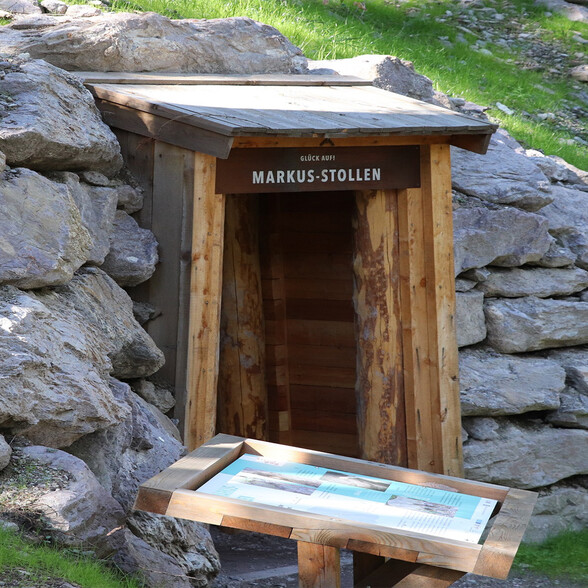
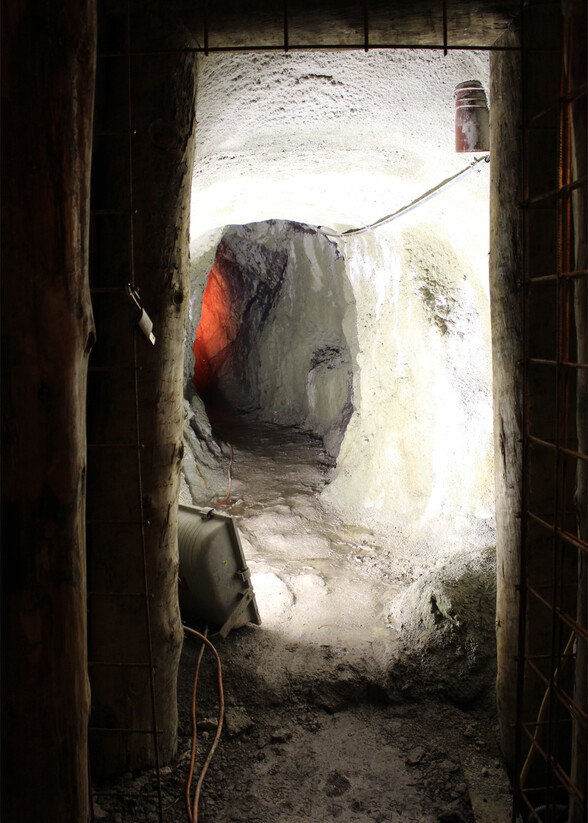
The former Gand Mine lies above St. Jakob am Arlberg, between 1,280 and 1,500m above sea level. It too was discovered by an amateur archaeologist, Markus Kaser. Although most local residents were familiar with the ”Knåppaloch“ or ”miners’ hole“ above St. Jakob, they were unaware for many years about an extensive tunnel system. The miners mined for so-called pale and silver ores, pyrite and chalcopyrite. The high mercury content in particular must have made the mining area very productive. Mercury used to be used widely in medicine, but it was also used for amalgamation, for example in gold mines. In the 16th century, the Gand Mine was the only one in Tyrol where this metal was mined so early. Old tunnels and three mining buildings, faithfully restored to their original state, allow visitors to travel back in time and learn about the arduous work that was performed here. A beautifully laid out, easy circular walk along the trail of the ore leads over 750 metres to three show huts and two mining galleries. Along the way, 12 boards provide information about geology, mineralogy, types of ore, historical development and the mining of the ores. At the ”Knåppaloch“ it is possible to walk twenty metres deep into the mountain through the timbered gallery during opening hours. The Markus Tunnel permits access up to 50 metres underground and can be explored as part of a guided tour since spring 2021.